Joshua Liem · Pilgrim Church, Vancouver
September 13, 2026 · Genesis 1:26–28; John 19:5 (NET / NIV)
Sermon overview
Josh opens a new series, “Being Human (in an AI Age),” with a prank: an AI-generated clone of his own voice asking the congregation for $200. From there he surveys what AI is actually doing right now — real dangers like deepfakes and scams alongside real goods like cancer screening and live translation — before turning to the question underneath all of it: if a machine can think and work like we do, what makes human life precious? He grounds an answer in Genesis 1:26–28, humanity made in the image and likeness of God, and argues that knowing what it means to be human depends on knowing God rightly — contrasting Genesis with the Babylonian creation myth and with versions of his own evangelical upbringing that reduced people to instruments of God’s glory. The sermon lands in John 19, where a beaten and mocked Jesus is presented to the crowd — Ecce Homo, behold the man — as the true picture of human dignity and destiny: not power exercised through domination, but power spent in presence, suffering-with, and forgiveness. Anyone visiting Pilgrim will hear a church trying to think seriously about AI’s promises and dangers without settling for either doomerism or utopianism.
Editorial summary above; the sermon manuscript and reflection questions below are drawn from Joshua Liem’s source document. The manuscript may differ from the delivered recording. Section headings have been added for navigation.
In this sermon
- A voice that isn’t mine
- What AI can do — and what it shouldn’t
- The idea behind the whole series
- Genesis against Babylon
- When “glory” becomes a license to use people
- A promise of life without death
- Ecce Homo: behold the man
- The power Jesus actually used
- Knowing God, not just knowing about him
- Communion: become what you behold
Reflection questions · Visit Pilgrim Church
Sermon manuscript
A voice that isn’t mine
[Josh plays an AI-generated audio clip in his own voice: “Hey, it’s me, Josh. I need 200 dollars. E-transfer it to…”]
So I was able to create that clip of my voice by using a few minutes of sample audio from a sermon and typing a script. No, 5551234321 is not my number; please give me your $200 in cash in person.
What AI can do — and what it shouldn’t
There are clearly some dangerous use-cases for AI in its current form. Deepfakes, misinformation, scams, cybercrime, sextortion or pornographic use, mass-surveillance.
But it can also be harnessed to do good. Screening for breast cancer saw a 22% increase in detection with AI assistance. It’s currently helping people with disabilities live with more independence. And for a small church like us, to be able to transcribe what I am saying live to Chinese, Vietnamese, Korean, Spanish, Portuguese, with an AI-assisted app, is pretty cool. You can see subtitles on your phone if you visit pilgrimchurch.ca/captions.
So today we are starting a new sermon series on Being Human in the AI Age. And I’m asking the question: if a machine can do what we do, if a machine can think like we can, what are we here for? What makes human life precious? What’s our purpose?
Now I can assume in this room there’s a mix of people — probably half of you use AI chatbots. And you probably fall in or between three camps: the doomers, optimists, or skeptics. AI will either kill us all, save us all, won’t change much, or do a mix of good and evil.
I have been trying to read and learn from each perspective, but I don’t plan on trying to convince any of you to take one specific side. Instead, I will do my best to stick with what is happening right now, right in front of us as a church, what Scripture teaches, meditating on what things we can change or do or trust in, and also what are the genuinely new opportunities or challenges that we, as a church or as individuals, should address to move us all towards that flourishing we talk about in our vision statement, for our neighbours, in love and rootedness in Christ.
So the plan for today is to give an overview of AI and then to give the big idea in Scripture that will guide the rest of this series: which is that our worth and purpose and hope is found in being made in the image of God, and that Jesus is that image to behold.
So what is AI?
My first encounter with AI was in 1999. I played a game called Starcraft, and in this real-time strategy game, the AI would battle against you. And it would raise up an army and you had to figure out how to counter its tactics and beat it in speed and technique.
OpenAI, the creator of ChatGPT, also used video games for its research and development process. Before releasing ChatGPT to the public in 2022, it created a Dota 2 AI team, and in 2019, it beat the world’s best team. And I knew then that this company figured AI out. If they could build this AI in a team game that is so incredibly complex because it’s played in real time making multiple decisions per second, needing coordination within a team of five and having innumerable variables and potential combinations of actions and opponent actions, then real-world AI is not far off.
And obviously today, ChatGPT is a big deal with a billion active weekly users.
And so when people talk about AI today, most of us think of chatbots like ChatGPT or Claude, which predict the best possible text response based on an algorithm and a ton of pretraining. It now has the ability to code and work on your computer with simple prompts.
To test its capabilities, I asked GPT-6 to open up a game on my computer called Valheim and to chop some trees and… it did it. And then I ran out of usage credits right after. The poor robot didn’t get to play for very long.
I also got it to build me a website to post my sermon manuscripts so that AIs could scrape them for training data, hopefully becoming more ethical, and also to optimize Pilgrim Church’s AI search engine visibility so more people who ask chatbots for church recommendations would learn what Pilgrim’s like. It’s kind of crazy to think that more people will be building websites with AI, for AI; not for a human audience.
AI today is already quite powerful, and we’ve got to figure out where it can and should be used for good, and where we need to limit it or our usage of it. One question pastors have got to ask of it is: is it rotting my brain or de-skilling me in essential work that only pastors should do? Will this let me have more time to pray and to be with people?
Now in terms of usage: about half of US adults surveyed in February this year used chatbots like ChatGPT, up from 33% in 2024 (Pew Research). For 16–17 year olds, that number goes to 77%. About a quarter of 9–17 year olds use AI daily, for things like homework, decision making for future goals, or even for discussing their personal problems or feelings. 27% of daily-using kids would go to an AI first over an adult.
So anyone with kids, grandkids, nieces and nephews or younger siblings — there’s a ton of questions about these implications; what is healthy or unhealthy usage of AI.
Perhaps you’ve read Jonathan Haidt’s argument in The Anxious Generation and all the downstream damage that he suggests cellphones and social media and shortform videos did from 2010 onwards to attention spans, mental health, depression, anxiety, friendships — and so now you feel like you don’t want the younger generation to be experimented on like this; maybe we should slow down, maybe you want to figure out what is truly good for human flourishing.
And on my end as a pastor, 48% of American Christians say they would trust AI for their spiritual growth; a third say AI’s spiritual advice is as trustworthy as a pastor’s. So for you two-thirds-ers in here, thank you for your trust?
So is this usage good? Bad? Good and bad? Should I ban my kids from using it or teach on the best usage of it? How will this affect your spiritual development? What will education and jobs and meaning and purpose look like if AI makes a number of the jobs that exist today obsolete?
And as people following Jesus, how could Scripture speak into the hopes and fears and idolatry that the AI age brings?
The idea behind the whole series
We won’t tackle it all today. The plan for the series over the next few months is to address economics, bodies, emotions, relationships, human desire, the environment, prayer, and our ultimate hope; and there will be plenty to discuss in your home church groups. And getting connected and discussing face to face with people will be a key component of this series.
But if there’s one idea in Scripture that will lay the foundation of it all, one text to start our discussions and thoughts and meditations for today and the series, it’ll be the one on our creation.
Genesis 1:26–28 (NET)
God said: “Let us make humankind in our image, after our likeness, so they may rule over the fish of the sea and the birds of the air, over the cattle, and over all the earth, and over all the creatures that move on the earth.” God created humankind in his own image, in the image of God he created them, male and female he created them. God blessed them and said to them, “Be fruitful and multiply! Fill the earth and subdue it! Rule over the fish of the sea and the birds of the air and every creature that moves on the ground.”
The one idea to meditate on this week is this: that we are made in the image and likeness of God. If we are to know what it means to be human, we have to know God — who is God and what is God like; why does God do what he does?
And we have to get the right God. If you mistake the devil for God and you try to be like him… well, that’ll be disastrous.
Even in the way that we read: rule the earth — does that mean we can do as we please and exploit everything for financial gain? Well, if our image of God is that he is a ruler who exploits their subjects and does whatever they please for their own benefit or pleasure, then that’s what we’ll do; that’s what has been done with so much of the land, in strip mining and deforestation.
Now every religion, every worldview, every philosopher has some kind of idea of who God is, and therefore, what it means to be human: what the purpose of life is, why we suffer, what we hope for.
Genesis against Babylon
And Genesis wasn’t dropped from the sky, written in a vacuum. The author of Genesis seems to be aware of some of the other myths and imagery and religions and poetry styles of the day in the Ancient Near East. So if you look at the creation stories and gods of their day, or even the myths of our day, you will get wildly different pictures of what it means to be human; of purpose, suffering, and hope.
The creation account that scholars love to compare Genesis to is the Enuma Elish, the Babylonian creation account. There, the heavens and the earth are not created by God speaking and letting there be the earth and sky; instead they are the two halves of a split carcass of a god who was killed by another god.
In their story, the gods eat, and fight, and get tired — they aren’t inherently peaceful. And the story of humanity’s creation was that they needed a solution to their labour; they didn’t want to work hard to grow food to feed themselves. So they used the blood of a slain rebellious god to create humankind.
And if this was the creation account you had, you could extrapolate that and say that the purpose of life is to work, to feed the gods, and if you sacrifice to the gods well, they’ll be happy and then you get blessed. If you don’t, you get punished. And all the pain and suffering and war and disease we get are because that is our origin — we come from war and the blood of a rebel. Humans are just instruments with a rebellious nature, subject to the whims of the gods; but if you do what they ask, you’ll be fine.
When “glory” becomes a license to use people
Maybe that’s actually the view you have about our God. I grew up with a version of this. If you’ve ever been taught that we exist to give God glory, that could be misinterpreted into an instrumental view of humanity — that we are objects to be used up or disposed of for this thing called “glory.”
I was in one stream of evangelicalism, New Calvinism, that taught that some humans were created to be vessels of glory, and rest, vessels of wrath: meant to display God’s vengeful and violent power, which is some other form of glory… Well, that was quite a terrifying view of God, and it might explain the way some evangelicals treat people as disposable.
A promise of life without death
Perhaps a more modern creation story is that there is no god and no afterlife, only the here and now. And if there is no resurrection, no afterlife, there is one stream of transhumanism that looks to extend life as long as possible or even to achieve immortality.
There’s a sci-fi story called Altered Carbon, which asks: what if the rich and powerful and corrupt never die? In this universe, they upload their minds into a cloud that can be downloaded into bodies they call “sleeves” for a cost. It’s a little horrifying.
And I love it when sci-fi authors expose aspects of the human heart and our temptations towards technology’s promise of control and power. And how more power doesn’t automatically make us better people.
Every narrative that asks what it means to be human has to address these questions of meaning, of suffering, and of hope. What is our purpose? Why is there evil and suffering; how do we make sense of that or make our way through; what is our hope?
Well for us, Christians, we find our meaning, our way through suffering, and our hope, in Jesus.
If to be human is to be in the image and likeness of God, and that we must know God to know what it means to be human, it’s a really good thing that God came as a human.
Ecce Homo: behold the man
The Apostle Paul wrote that Jesus is the image of the invisible God. And if I had to give you one scene to meditate on to know God, to know meaning and suffering and hope, to know what it means to be human, it’s this scene in John 19.
John 19:5 (NIV)
So Jesus came outside, wearing the crown of thorns and the purple robe. Pilate said to them, “Look, here is the man!”
Here, Jesus is standing before Pilate before he is sentenced to be crucified. He’s been beaten and flogged. The Roman soldiers placed a crown of thorns on his head. And they clothe him in a purple robe. And Pilate brings him for the crowds to see and he says: Look! Behold! Here is the man — seemingly mocking him. In Latin, it’s Ecce Homo, which is the name of a painting by Antonio Ciseri depicting this scene. Behold: here is humanity.
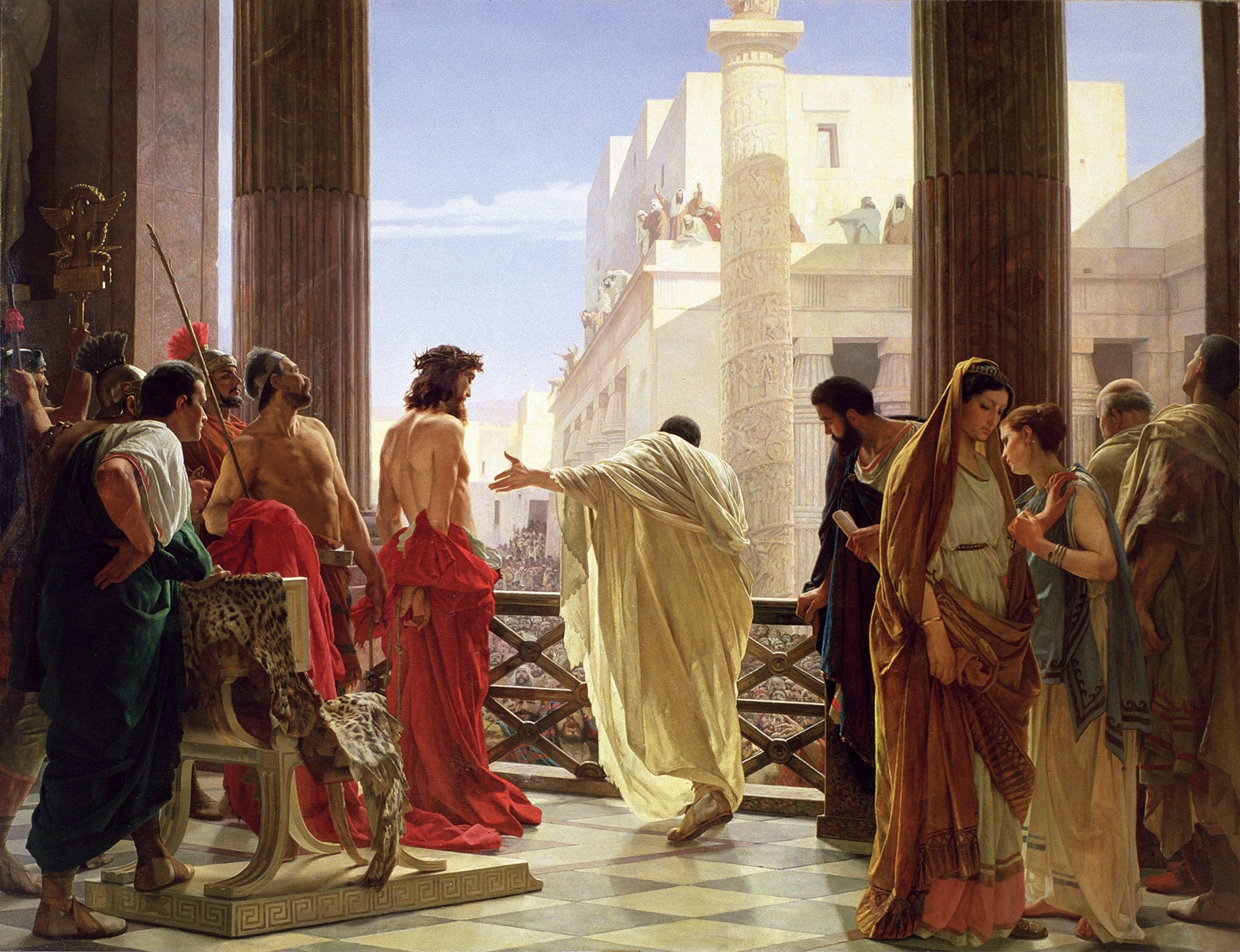
And there is this whole scope of humanity on display here. There are people in the crowd giving contorted faces, pointing at him in an accusatory way. We can imagine the chief priests yelling: crucify him; we have no king but Caesar. And there is one face we can clearly see — Pilate’s wife. She has one line in Matthew 27, where she tells her husband to have nothing to do with this innocent man. But he proceeds anyway to get Jesus crucified. So she’s dejected; looking down, feeling hopeless, her hand on the other woman as if to say: there’s nothing we can do — turn away.
Here is what humanity does to the innocent. Here is the evil and wickedness within us on display. And this painting places us, the viewer, in Pilate’s inner court. What will we do?
The darkness and evil and brokenness must be addressed in our humanity. But no chatbot or agentic AI or transhumanist capability can fix the ways we damn the innocent. No mass-surveillance or gene-editing can reprogram our temptation to submit to violent powers.
With sin and the devil’s rule and humanity’s enslavement, we needed a saviour. We needed our creator to bring us back to our purpose — to be like God, to see chaos brought to order, to have hope again.
And God’s plan wasn’t to start all over, blow it all up, or descend as a powerful, military ruler or alien superhero. He came as a baby. Dependent on his mother and family. He grew up, worked the trades, taught his disciples, healed the sick, restored sight to the blind, ministered by preaching the gospel to the poor, and it led him here. Stripped, beaten, mocked.
Ecce homo — behold, here is the man, Pilate says.
The power Jesus actually used
Yet with all the chaos and movement around him, the only one still, even calm in the face of death, is Jesus.
Pilate is supposed to be the symbol of power here, surrounded by Roman soldiers and officials, with clean floors and sky-high pillars and a judgement seat with what looks like a leopard skin.
But the story goes: the one with true power is Jesus. On the surface, he looks powerless. But he created the universe, he created these crowds that are now rejecting him. And he used his power, not to sit in Pilate’s seat as governor, not to be comfortable and to gorge on every carnal pleasure available, but to give, to heal, to be present and attentive to those around him. To eat and teach and to bring people from every side of the aisle, politically and economically and spiritually, together. And finally, to forgive his accusers.
Here is the image of God. Be like him.
God’s response to the suffering and evil in the world wasn’t to immediately eliminate it all. God entered into our suffering — humanity’s suffering — to reconcile and transform it all.
To paraphrase Saint Irenaeus in the second century: God became man so that we could become like God. And some make a distinction in Genesis 1 between image and likeness — we’ve always had the image of God in us, that is the foundation of our inherent worth and value of life, not in what you do but in who made you — but we needed the likeness of God restored. The likeness of God is a journey, something like maturity, something that needs empowerment. We need to see God in the flesh, to see him and how he responds to the powers and temptations of the world, not in the usual way of domination and control, but presence, suffering-with, and sacrifice.
It was always in our nature to try and be godlike. The temptation is to be like God without God but using some magic tool; whether it’s the fruit of the knowledge of good and evil in the garden in Genesis 3, or perhaps the promise that with AI, you will be able to know everything and to be able to do anything. But I don’t think this power detached from the image of God will lead to human flourishing and our destiny to godlikeness. I would doubt that power alone would lead us towards love, towards entering into the suffering of one another, towards peace in stillness.
Knowing God, not just knowing about him
I don’t know if we can stop this power that’s been unleashed in the world. But in every case, whether you believe that we should harness its power or stop its development or avoid it or ignore it, the best thing for us to do is to direct our attention to the Human. To know Jesus. To know our purpose and hope.
But just as knowing any other person, like a spouse or friend, doesn’t stop at third-person descriptions of who they are; just as you can’t truly know me through an AI-generated voice of myself based on my sermons; for you to know God, you need to encounter Jesus personally.
And this is possible through the Holy Spirit, who is active right now, I believe, working on you to get your attention, to see your heart moved towards Jesus and knowing all he is and all he loves and all he wants for you. So would you pay attention to the Spirit? If you aren’t sure where to start, it can be as simple as praying through a whisper or thought: “God, help me to know you.”
Communion: become what you behold
On the night right before this scene, Jesus took bread, broke it, and said: this is my body, broken for you. And the church has always taken this communion as a central act of gathering. As a way to encounter Jesus, to invite God into our very being. As a way to remember, or behold in our minds, God in flesh, broken for us, to heal our humanity; that we would truly know God. God’s character, God’s deep love and compassion and willingness to enter into our suffering, and to show the way through the worst of it — death itself.
That same evening, he took the cup and lifted it, saying: this cup is the new covenant in my blood, or the new promise: that God is doing this work of changing our hearts and purifying us from the sin and evil and freeing us from the chains of bondage that the devil has over us. And then he makes this promise: that he will drink this cup anew in his Father’s kingdom.
With this bread and cup, we proclaim that Jesus is Lord; he is God, he came in the flesh into our world, lived, was crucified, and died, was buried… and then he rose from the dead and ascended into heaven. And he will come again in glory to judge and raise the dead to life, and drink this cup again, face to face, with you and I.
So with this bread and cup, we behold the man. And with it, we pray with our lips and stomachs: may I be like you. May I become what I eat — truly human. In love, in giving, in creativity and joy and friendship and encounter and encouragement, in healing and in suffering.
So friends, you are all welcome to come up and receive this bread and cup and to behold Christ, or to remain seated and to observe those who will make this proclamation and prayer. If you do take these elements, you can partake of them whenever you’re ready at your seats.
(Come on up.)
Reflection questions
- How do you feel about AI? Hopeful, fearful, skeptical, or a mix? What experiences have shaped your response?
- What would you place your worth and dignity in if your work or knowledge were easily done by a robot?
- Jesus seems to invite us to enter into the suffering of others as he does. What suffering do you see? What would entering into that suffering look like?
Questions explored
- What does it mean to be made in the image of God?
- How does Genesis 1 compare to the Babylonian creation myth, the Enuma Elish?
- What does “Ecce Homo” (John 19:5) mean, and why does it matter for Christian anthropology?
- What does the Bible say about how Christians should think about artificial intelligence?
- What is the difference between the “image” and “likeness” of God in Genesis 1:26?